
How it Works | KISS Institute for Practical Robotics

From Your First Decision to the Final Mission

Your Botball Explorer Journey Starts Here.

Choose the right division, select your robot, build to the program rules, program for autonomous operation, and put your solution to the test on the official game field.

Each step moves students closer to completing real autonomous missions while building their programming, engineering, teamwork, and problem-solving skills.

Start With Step One
M Mission Checklist Ready
Botball Explorer Team Journey

Mission Preparation

  1. 1 Division Selected Complete
  2. 2 Robot Ready Complete
  3. 3 Rules Verified Complete
  4. 4 Program Tested Complete
  5. 5 Mission Launched Complete
Find the Right Challenge

Pick Your Division

Discovery and Expedition use the same game and mission-based format, but each division provides rules and recovery options appropriate for its students.

Approachable Starting Point

Discovery

Grade 6 and Below

Discovery introduces students to autonomous mission challenges with additional flexibility for field setup, robot recovery, and troubleshooting during matches.

  • Designed for younger and newer students
  • Flexible game-piece setup before a match
  • Unlimited recovery touches
  • Teams may choose to play up into Expedition
Advanced Challenge

Expedition

Grades 7–12

Expedition challenges students to develop more advanced, reliable solutions using the standard game setup and more limited recovery opportunities.

  • Designed for older and experienced students
  • Standard game setup
  • Two tournament timeout cards
  • Approved 3D-printed parts are permitted
Select Your Equipment

Choose Your Robot

Start with the complete Botball Explorer Robot Kit or use another qualifying platform capable of autonomous operation.

Complete Classroom Option

Botball Explorer Robot Kit

A complete system designed specifically for the program and ready for classroom building and autonomous programming.

  • Two Wombat robot controllers
  • LEGO and metal building components
  • Motors, servos, and sensors
  • Wireless browser-based programming
  • No power tools or machine shop required
Explore the Robot Kit
Use Existing Equipment

Qualifying Autonomous Platform

Build on your existing robotics investment with a platform that can operate autonomously and meet current program rules.

Potential Platforms Include:
VEX IQ LEGO Mindstorms LEGO SPIKE Prime Makeblock Arduino Raspberry Pi micro:bit Other Platforms
  • Must operate without a driver or remote control
  • Must meet current size and construction rules
  • Must satisfy all program safety requirements
Prepare for Inspection

Build to the Rules

Before taking the field, confirm that every robot meets the current size, construction, safety, and autonomous-operation requirements.

Pre-Match Inspection

Is Your Robot Ready?

Use this checklist throughout the build process—not only when the robot is finished.

Official Starting Box
Inspection Ready All requirements verified
1
Starting-Box Fit

The complete robot must fit within the official starting box at the beginning of a match.

2
15-Inch Starting Height

The robot may not exceed 15 inches in height while in its starting configuration.

3
Up to Two Robots

A team may use up to two autonomous robots during its competition run.

4
Autonomous Operation

Robots must operate without a driver, joystick, or remote control after the match begins.

5
Safe and Compliant Construction

Every component and construction method must satisfy the current division, equipment, and safety rules.

The Official Rules Are the Final Authority
Continue to Step 4
Create the Autonomous Solution

Program for Autonomy

Write the code that allows your robot to gather information, make decisions, and complete missions without a driver, joystick, or remote control.

Autonomous Programming Workflow

From Sensor Data to Robot Action

1 Sense Read sensors and gather information from the field.
2 Decide Evaluate conditions and choose the next action.
3 Act Control motors, servos, and mechanisms.
4 Test Run the program on the field or in the simulator.
5 Improve Evaluate results, troubleshoot, and refine the solution.
Repeat Until the Mission Is Reliable
Wombat Programming Options: C C++ Python Graphical (Coming Soon)
Reliable Solutions Come From Repeated Testing
Continue to Step 5
Launch the Mission

Compete on the Field

Put your programming and engineering to the test as your autonomous robots complete missions, earn points, and improve throughout the event.
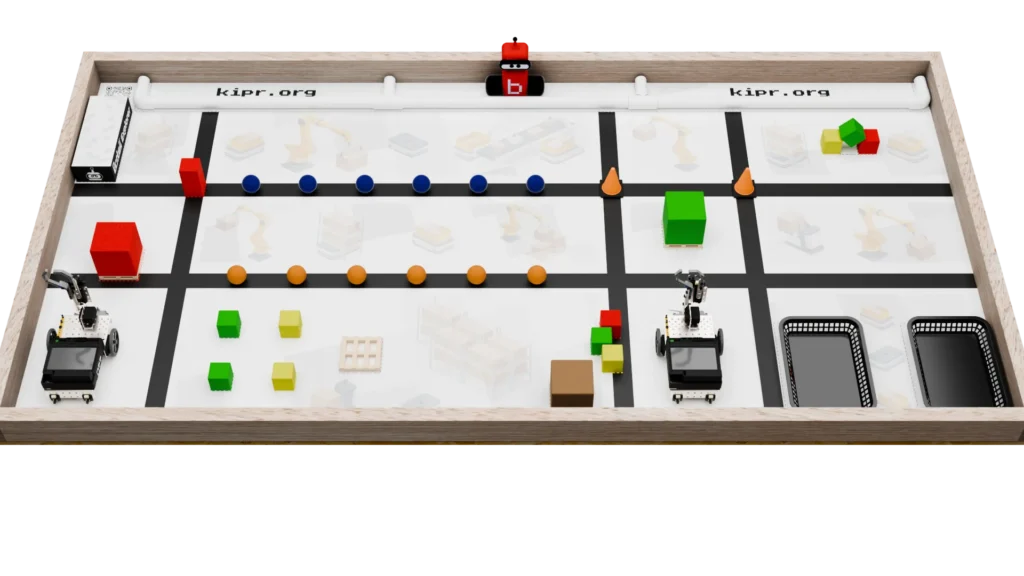
Stack Attack Botball Explorer competition field
2026-2027 Game Stack Attack
Mission Field Ready to Run
Competition Format

Five Opportunities to Improve

Teams complete five scored matches, with their best four scores counting toward the final result. Each run gives students an opportunity to evaluate performance and refine their strategy.

150 Seconds Per Match Division recovery rules apply.
2 Robots Allowed Both robots must operate autonomously.
5 Scored Matches Teams can improve between runs.
Best 4 Scores Count One match score is dropped.
1 Run 2 Evaluate 3 Improve 4 Run Again
The goal is not simply to complete every mission. It is to choose a strategy, execute it consistently, and improve throughout the event.
Detailed Program Rules

Compare the Divisions

Discovery and Expedition share the same autonomous game but use different field, recovery, and construction rules.

Program Detail Discovery Expedition
Eligibility Grade 6 and below Grades 7–12
Play Up May play up into Expedition May advance into the Botball program
Field Setup May remove game pieces from the field before the match Standard game setup
3D-Printed Parts Not permitted One large part smaller than 220 × 220 × 250 mm and up to six small parts smaller than 75 × 75 × 85 mm
Recovery Method Unlimited recovery touches; the robot returns to its starting box and the match clock continues running Two timeout cards per tournament; the match clock stops during the timeout
Recovery Penalty Five percent of the final score for each touch outside the starting box The controlled object is removed from play; no score penalty
Match Length 150 seconds with no timeouts 150 seconds; timeout periods do not count against the match time
Robots Allowed Up to two autonomous robots Up to two autonomous robots
Tournament Format Five matches; the best four scores count Five matches; the best four scores count
Division Award Discovery Champion Expedition Champion
Your Next Mission Starts Here

Ready to Begin Your First Mission?

Choose your starting point, register your team, and give students a hands-on autonomous robotics experience built around programming, engineering, and creative problem-solving.

Want to see the game first? Preview the 2027 Stack Attack game →